Customizing NetSuite for a Recycling or Scrap Business: Build It Yourself or Buy Purpose-Built?
Customizing NetSuite for a Recycling or Scrap Business: Build It Yourself or Buy Purpose-Built?
If you run a recycling, scrap, or materials business and you've decided NetSuite is your platform, you have two paths: hire a development team to customize it for your operation, or buy a solution where that work is already done. We've built these customizations for years, so we can tell you exactly what each path costs and where each one makes sense.
Customizing NetSuite for a recycling business means extending the platform's standard order-to-cash and procure-to-pay workflows to handle operations NetSuite was never designed for: inbound material ticketing, scale and weighbridge integration, grading and regrading, weight-based pricing, and settlement-based payments. Out of the box, NetSuite assumes you buy known quantities of fixed SKUs and sell finished goods. A scrap yard runs the opposite direction. Material arrives in unknown quantities and unknown condition, gets weighed, graded, sometimes transformed, and the price is often set after the transaction starts, not before.
That gap between what NetSuite assumes and what your yard does is the entire customization project. Here is what closing it actually involves.
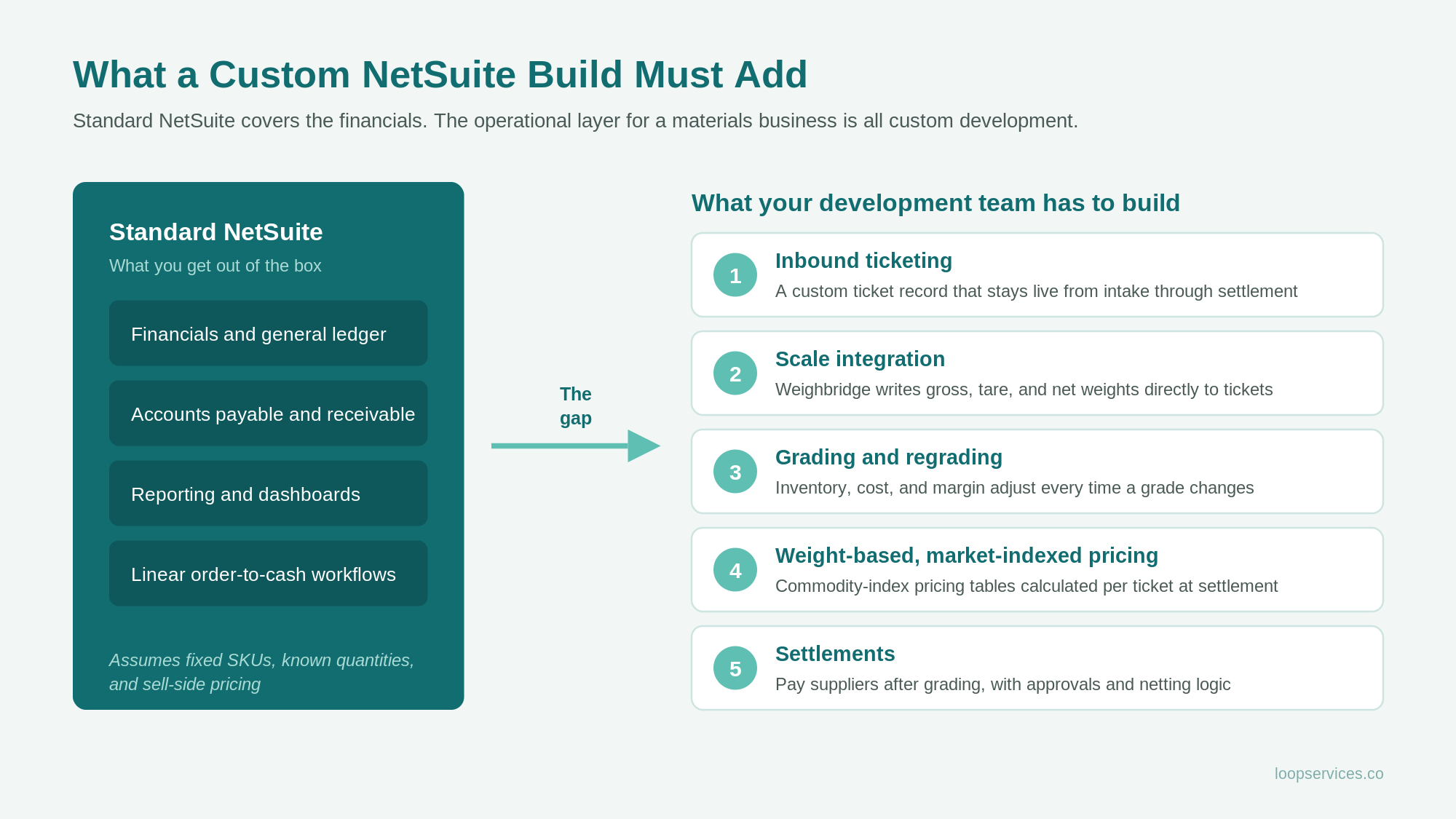
What a Custom NetSuite Build for a Materials Business Requires
Inbound ticketing
Every load that crosses your scale needs a ticket that opens at intake and stays live through grading, processing, and settlement. NetSuite has no native ticket object. Your development team builds one: a custom record type with workflows connecting it to inventory, purchasing, and payables. This is the backbone of the whole system, and every other customization depends on it being right.
Scale integration
Your weighbridge needs to write directly to those tickets. That means middleware or a custom integration between scale hardware and NetSuite, with gross, tare, and net weights captured automatically. Manual weight entry defeats the purpose and introduces the errors you bought an ERP to eliminate.
Grading and Production Entries
Material comes in as one thing and often becomes another. A load ticketed as shred may transform into multiple commodities at different values. NetSuite's standard inventory model has no concept of this. You need custom logic that adjusts inventory, cost, and margin whenever a grade changes and keeps the audit trail intact.
Weight-based, market-indexed pricing
Scrap prices move daily and vary by supplier, grade, and volume. A custom build needs pricing tables tied to commodity indexes, with formulas that calculate per-ticket pricing at settlement time. NetSuite's price levels were designed for wholesale catalogs, not for COMEX-linked spreads.
Settlements
Recyclers receive and potentially pay suppliers based on what the material graded out to, which means the payable is calculated after receipt, sometimes weeks after. Building settlement functionality means custom records, approval workflows, and integration with NetSuite payables, plus netting logic if you both buy from and sell to the same trading partners.
Add dispatch management, driver mobile apps, compliance documentation, and camera integration if your operation needs them. Each is its own workstream.
The Realistic Timeline and Cost
A competent NetSuite development partner can build all of this. We know because this is the work we do. But go in with accurate expectations.
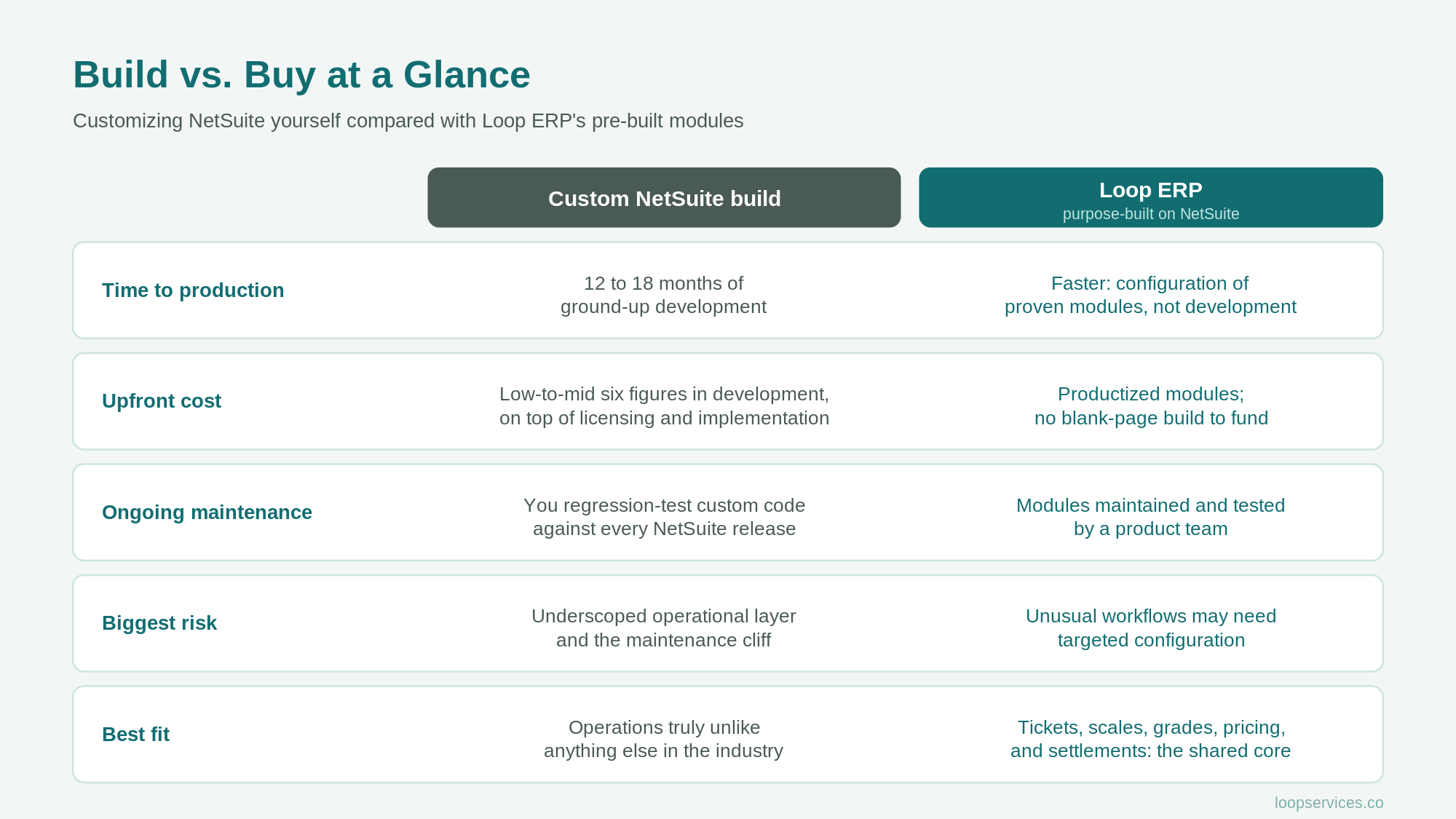
A full custom build for a mid-sized recycling operation typically runs 12 to 18 months from kickoff to stable production use. Budget depends heavily on scope, but a build covering ticketing, scale integration, grading, pricing, and settlements generally lands in the low-to-mid six figures for development alone, on top of NetSuite licensing and standard implementation. Then plan for ongoing cost: every NetSuite release needs regression testing against your custom code, and the developers who built your system need to stay available, or their knowledge leaves with them.
None of this makes custom development the wrong choice. It makes it a choice you should price honestly.
Where Custom Builds Go Wrong
We've been called in to recover enough stalled ERP projects to see the pattern. Custom builds for materials businesses fail in predictable ways.
The most common failure is underscoping the operational layer. The project plan covers financials thoroughly because that's what NetSuite partners know, and treats ticketing and grading as a few custom fields. Six months in, the team discovers the yard's actual workflows, and the budget doubles.
The second is designing from the org chart instead of the scale house. If the people specifying requirements have never watched a load get transformed at 6 a.m., the system will model how managers think the yard works rather than how it works. Adoption dies at the gate.
The third is the maintenance cliff. The build works at go-live. Two years later, the original developers are gone, a NetSuite update breaks a script, and nobody left on staff understands the customization well enough to fix it quickly.
The Purpose-Built Alternative
This is why we partner with Loop ERP, a NetSuite-based ERP built specifically for recycling, scrap, and circular economy businesses. Everything described above already exists as productized modules: ticket management, inbound logistics with scale integration, inventory and production, flexible pricing, and finance and settlements, all running natively on NetSuite.
The practical difference is risk and time. A Loop ERP deployment configures proven modules around your workflows instead of designing them from a blank page. You get to production faster, the modules are maintained and tested against NetSuite releases by a product team rather than by whoever built your custom scripts, and the workflows were designed by people who have run materials businesses. You still get NetSuite integrated: same financials, same reporting, same platform.
How to Decide
Build custom when your operation is truly unlike anything else, when you have (or will fund) a long-term development relationship, and when the 12-to-18-month timeline fits your business plan. Some operations have workflows unusual enough to justify it, and we build those systems.
Buy purpose-built when your core needs are the ones every materials business shares: tickets, scales, grades, prices, settlements. If Loop ERP's modules cover 90 percent of your requirements, paying to rebuild them from scratch buys you nothing but risk. The remaining 10 percent can be handled as targeted configuration, which is a far smaller project than a ground-up build.
Either way, insist on a partner who can show you a working recycling workflow before you sign, not a slide deck about one.
Frequently Asked Questions
Can NetSuite handle a recycling or scrap business out of the box? No. Standard NetSuite handles the financial side well but has no native support for inbound ticketing, scale integration, grading, weight-based pricing, or settlements. Every materials business on NetSuite closes that gap through custom development or a purpose-built solution like Loop ERP.
How much does it cost to customize NetSuite for a recycling business? Development costs for a full operational build (ticketing, scale integration, grading, pricing, settlements) generally reach the low-to-mid six figures, in addition to NetSuite licensing and implementation. Ongoing maintenance adds to that every year.
How long does a custom NetSuite build take compared to Loop ERP? Custom builds typically take 12 to 18 months to reach stable production. Loop ERP deployments move faster because the modules already exist and implementation is configuration, not development.
Is Loop ERP a separate system from NetSuite? No. Loop ERP runs natively on NetSuite. You keep NetSuite's financials, reporting, and platform, with industry modules for recycling and materials operations layered on top.
What if we already started a custom build that isn't working? That's a common situation, and it's recoverable. Our project recovery team can assess what's salvageable and whether migrating to Loop ERP modules is faster than finishing the build.
Talk to the Team That Builds Both
Loop Services implements NetSuite, builds custom solutions, and partners with Loop ERP. That means we have no reason to push you toward the more expensive path. Book a call, and we'll walk through your workflows and give you an honest read on whether your operation needs a custom build or whether Loop ERP already solved your problem.